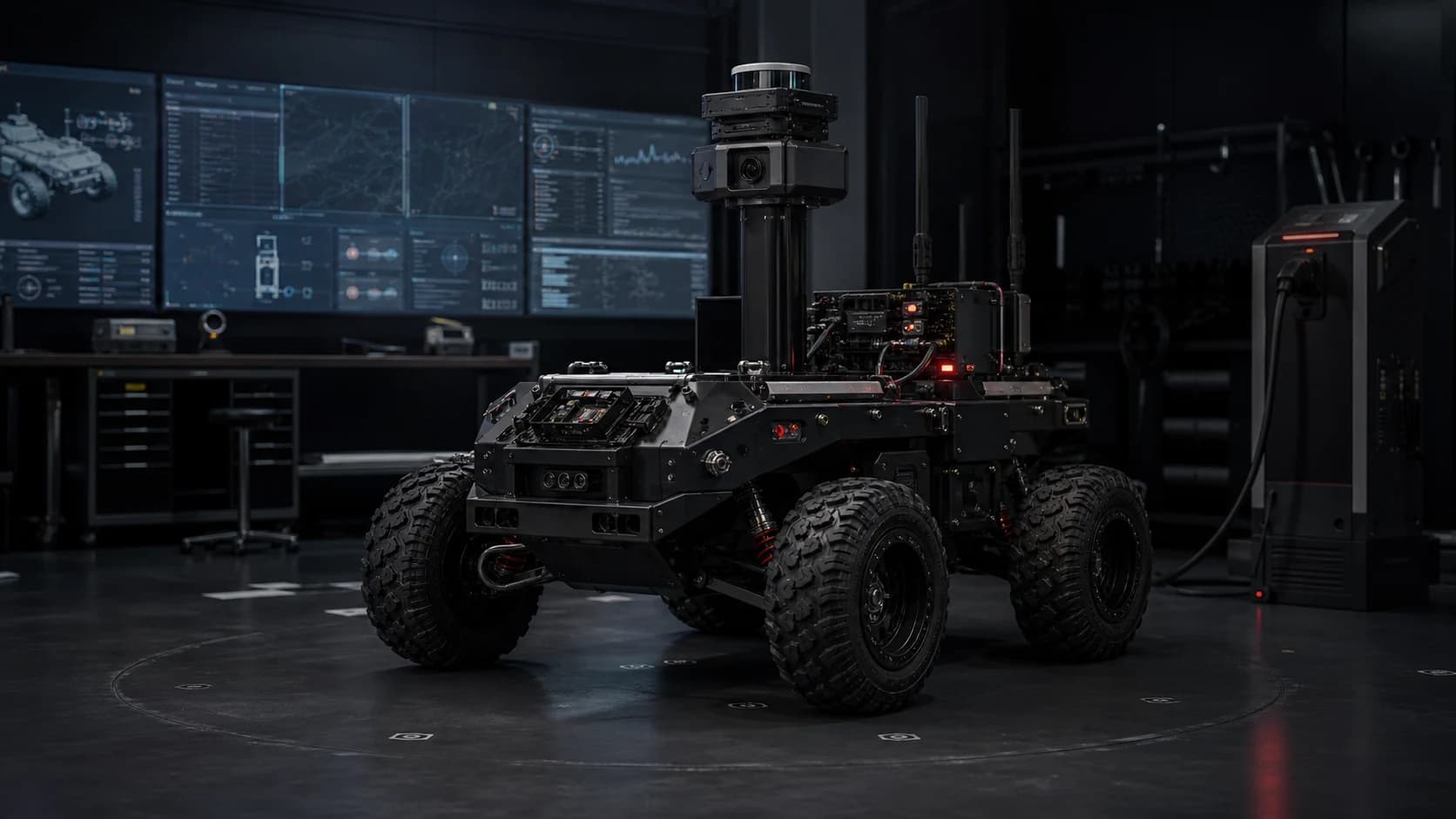
An unmanned ground vehicle is a land platform capable of performing defined tasks through remote control, semi-autonomous assistance or a preplanned mission flow. UGVs can support defense, security, logistics, reconnaissance, critical infrastructure inspection and hazardous-area assessment. Their value is not limited to keeping personnel away from risk; they also enable persistent observation, modular payloads and repeatable data collection.
Core architecture
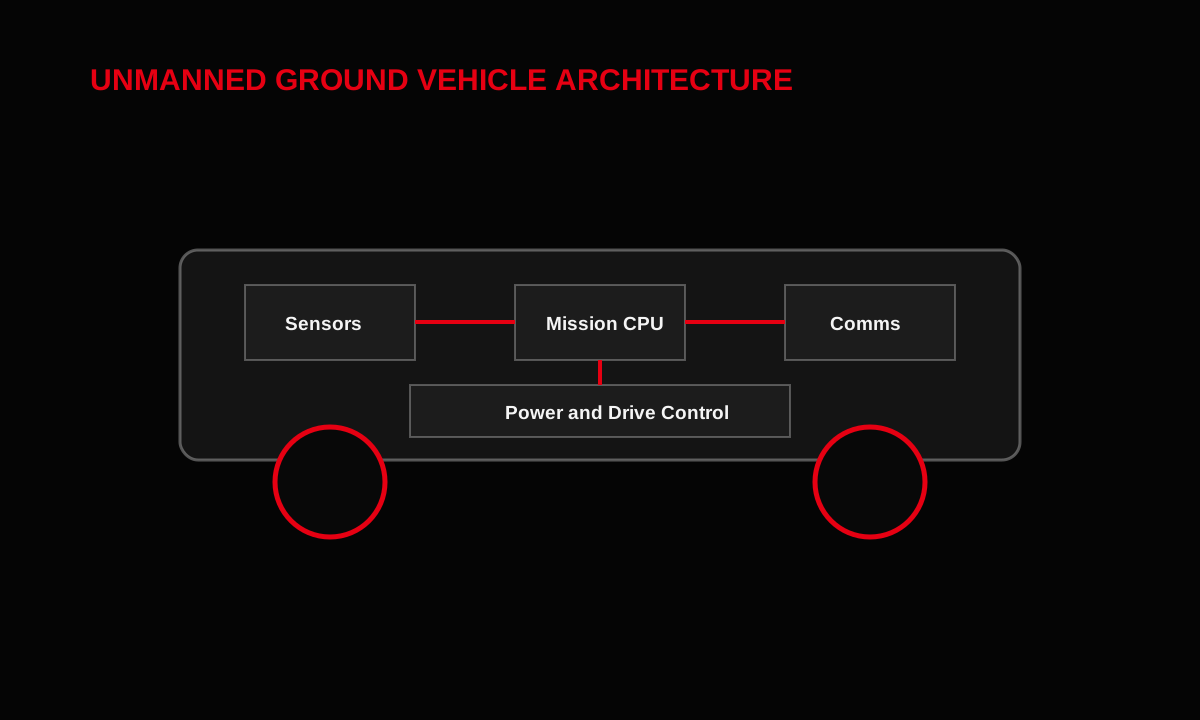
A UGV platform consists of a mechanical chassis, mobility system, battery or power distribution layer, mission computer, sensors, communications unit, safety layer and user control interface. Even if individual components are powerful, field performance will be weak if the system is not balanced at architecture level. High-resolution sensors, for example, produce limited value without appropriate data paths and power budgets.
Use cases
Unmanned ground vehicles may be used for perimeter security, base-area monitoring, critical facility observation, reconnaissance, logistics support and post-disaster search activities. Public content should frame these use cases in generic and defensive terms. Operational tactics, engagement approaches or sensitive capability details should not be included in blog material.
Technical components
The mission computer acts as the central coordination unit of the platform. It processes sensor data, interacts with the communications layer, transfers operator commands to the control system and applies safety rules. Sensors may include cameras, lidar, radar, inertial measurement units or environmental sensors depending on the mission. More sensors do not automatically mean a better system; integration quality is decisive.
- Modular payload interfaces
- Reliable communications and low-latency control
- Mechanical and thermal design suitable for harsh field conditions
- Field maintenance, battery replacement and rapid configuration
Maturity criteria
For institutional buyers, one of the most important indicators of UGV quality is mission continuity. The platform must be evaluated under mud, vibration, temperature, humidity, electromagnetic effects and communications constraints. Software update processes, logging, fault diagnosis and configuration management are also part of product maturity.
In conclusion, an unmanned ground vehicle is not just a robotic platform. It is a controlled system architecture. A defense-oriented UGV becomes field-ready when reliability, traceability, modularity and mission fit are demonstrated through disciplined engineering and verification.