
GPS-denied navigation is a critical engineering problem for modern unmanned systems. Satellite-based positioning is not always available, reliable or sufficiently accurate. Indoor areas, dense urban environments, underwater operations, terrain masking or electromagnetic risk can limit position information. For defense systems, alternative positioning methods are therefore part of mission continuity rather than optional enhancements.
What does the problem mean?
GPS-denied navigation refers to the ability of a system to maintain position, orientation and motion awareness when GNSS signals cannot be used or cannot be trusted. The issue is not simply producing coordinates. The platform must follow its mission plan, place sensor data in the right context and provide reliable status information to the operator.
Alternative methods
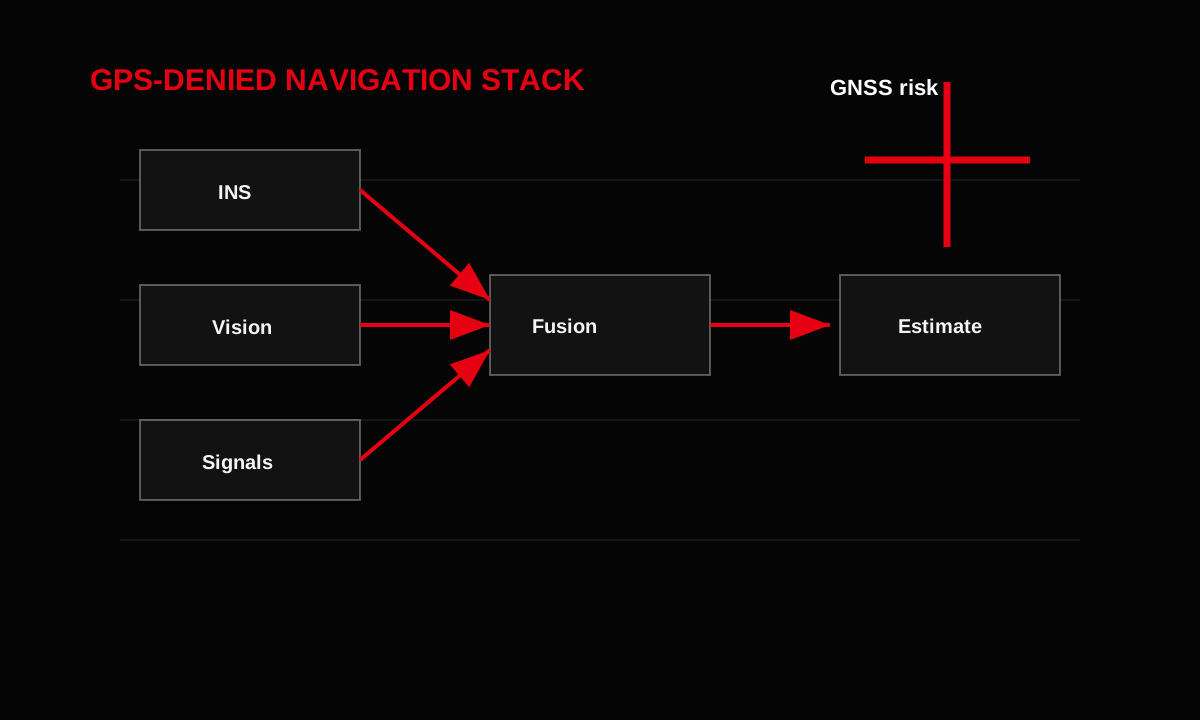
Inertial navigation systems estimate motion through acceleration and angular-rate measurements. Visual navigation uses camera data to track environmental features. Lidar or radar-based mapping can support position estimation by modeling the surrounding environment. In some scenarios, magnetic, barometric or acoustic methods may also provide value. Each method, however, has error growth, environmental dependence and processing cost.
Sensor fusion
Relying on a single sensor is risky. Sensor fusion combines data from different sources to produce a more balanced and reliable position estimate. A well-designed fusion architecture prevents the system from becoming blind when one source weakens. The important factors are not only algorithms, but also time synchronization, calibration, error models and the quality of test scenarios.
- INS for short-term motion continuity
- Visual or lidar-based environmental matching
- Map-assisted position validation
- Time synchronization and error handling in the mission computer
Value in defense systems
GPS-denied navigation increases mission flexibility across unmanned land, air and maritime systems. Public content should remain away from sensitive operational details. The right emphasis is resilient architecture, sensor diversity, verification discipline and human-supervised mission management.
In conclusion, GPS-denied navigation is not solved by adding a single backup sensor. A reliable solution combines multiple positioning sources through systems-engineering discipline, anticipates error conditions and is validated under realistic field constraints.