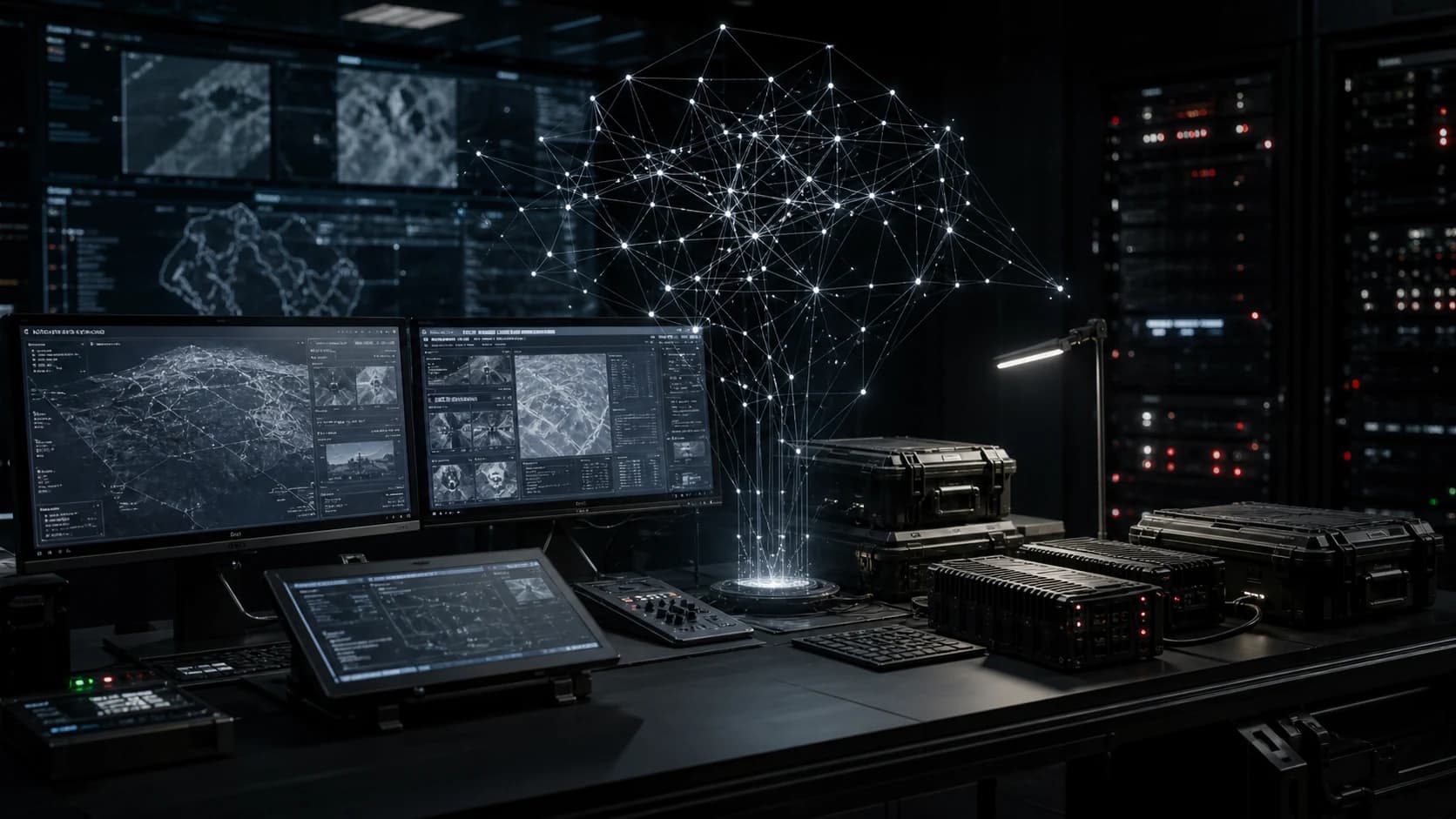
Artificial intelligence in the defense industry should not be framed as an unrestricted autonomous decision-making claim. The correct frame is perception, classification, data processing, mission planning, predictive maintenance and human-supervised decision support. Defense AI systems require high reliability, explainability, data quality and controllability.
Use cases
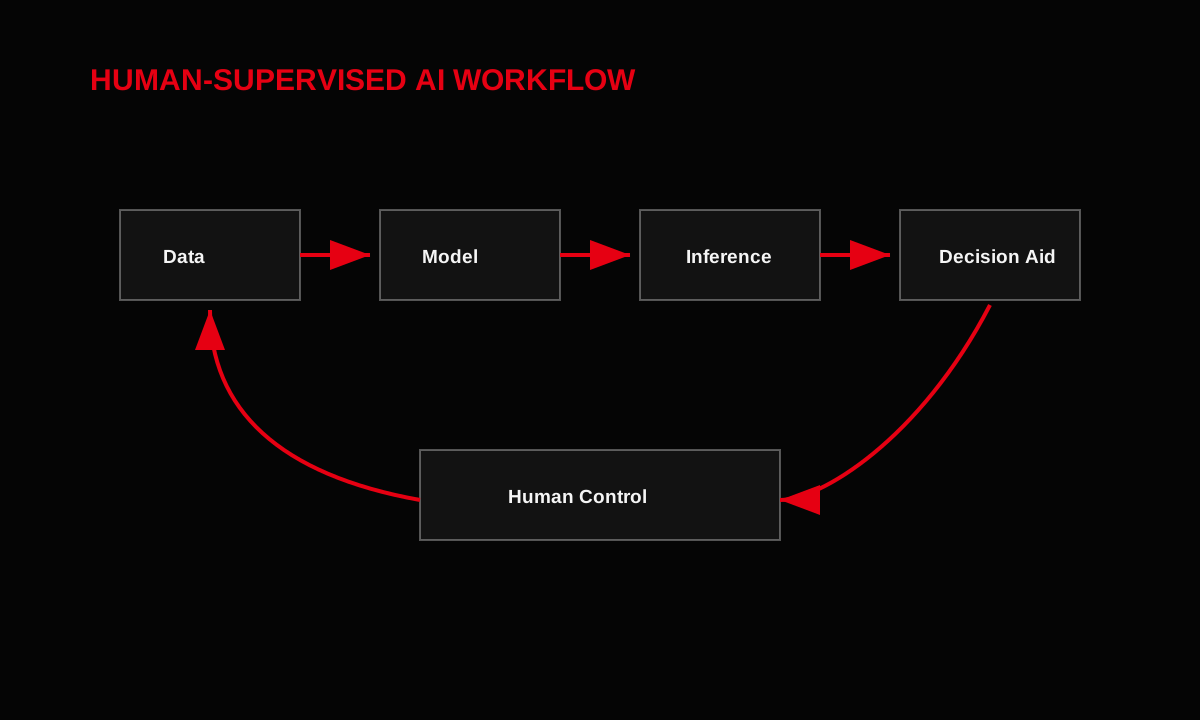
AI can be used in image processing, sensor-data analysis, anomaly detection, logistics optimization, predictive maintenance, mission planning and operator-support interfaces. The common objective is to reduce information burden and extract meaningful signals from large data flows. However, final responsibility and mission context must remain within human oversight.
Why data quality is critical
The performance of an AI system depends on more than the algorithm. Representativeness of training data, labeling quality, environmental diversity, sensor characteristics and test scenarios directly affect results. In defense contexts, datasets may be limited, sensitive or irregular. For that reason, validation, traceability and secure data management are fundamental requirements throughout model development.
Edge AI and field reality
Field systems cannot assume continuous high-bandwidth connectivity. Some AI functions must therefore operate at the edge, directly on the deployed device. Edge AI supports low latency, local data processing and mission continuity. At the same time, processing power, energy consumption, thermal design and secure update mechanisms must be managed carefully.
- Human-supervised decision support
- Explainable and testable model behavior
- Secure data management and access control
- Processing and energy balance suitable for field conditions
Risks and limits
The riskiest language around defense AI is language that separates the system from human responsibility or productizes engagement decisions. A reliable institutional narrative should focus on safe autonomy, classification support, mission planning and operator awareness. Model error, data drift and adversarial risk should also be acknowledged rather than ignored.
Ultimately, AI can create a strong force multiplier when managed with engineering discipline. A reliable system is not merely one that appears intelligent; it is one whose limits are defined, whose behavior is tested and whose operation is compatible with human control.